Professional Risk Management: A Valuable Initiative for a Group Practice
Over the past 30 years, I have developed a program for managing malpractice risks that has worked over and over again.
This program has helped bring down claims, reduce payouts, lower malpractice premiums, and improve the quality of care. So, how did I achieve this? Let me walk you through it.
Malpractice Risk Management Should Be Proactive
One thing you should know is that most medical groups treat malpractice reactively. When a physician and medical group are served with a malpractice suit, they tender the claim to the insurance carrier, and the carrier appoints counsel to represent the physician and medical group. It is mainly the insurance company – and not the medical group – which takes the lead on the case.
This approach is passive and its effectiveness is suboptimal.
A professional risk management program changes all that. Rather than a passive approach, it treats malpractice as something to be actively managed. You have to track, analyze, and mitigate risks proactively before the claim arrives.
When you follow this system, you will save costs and improve the quality of care you provide. This happens because you now systematically examine why claims happen by uncovering charting habits, communication breakdowns, and process gaps.
Consequently, you will lower your legal exposure and institutionalize better care, making cost savings your driving force and quality improvement your dividend.
How Malpractice Risk Management Works
Now, to achieve these results, you must start with something very simple: a litigation tracker.
A litigation tracker is a worksheet that lists every active case, with columns for every detail that matters. It should have:
- The physician named as the defendant
- The plaintiff
- The hospital named as the co-defendant if there is one
- The date of loss
- The plaintiff’s attorney
- The defense attorney
- The case number
- A description of the alleged occurrence, and
- The expert
The worksheet should also contain closed cases, including their disposition, that is, whether it was settled, dismissed, tried, won, or lost, and for how much. This worksheet is important because if you examine all this information individually, you might not gain much. But assembled in one place, you will see trends you never knew existed.
For example, you’ll be able to identify the physician who is getting sued the most, and it might not be who everyone expects. Also, you will find answers to questions like:
- Is a single plaintiff’s firm suing your group repeatedly, and if so, what is it about your practice that makes you their repeat target?
- Are your claims clustered in a particular year, and was there something about that year that explains it?
- Are the cases concentrated in a particular category — failure to diagnose, infection cases — that point to a fixable pattern?
In a state like Illinois, the first four digits of a case number tell you the year the case was filed. When you compare the date of loss to the time of filing, a gap of nearly two years is often seen. What does this tell you?
It means the case was shopped around and was filed right at the edge of the statute of limitations. This means it was difficult to find an attorney willing to take the case or to find an expert to opine that malpractice occurred. If you have a good number of such cases in your litigation tracker, it shows you that you are managing risk well.
Your practice or physician group has stopped being an easy target. But if the reverse is the case, it means you are an easy target and are not managing your risk well. So, you can see why it is essential to have a tracker.
A Dedicated Risk Manager is Non-Negotiable
But a litigation tracker is just a document. What makes your malpractice risk management efforts worthwhile is having a dedicated risk manager. In larger medical groups that I have represented, this person is not always a lawyer, and they serve the group full-time.
The risk manager does more than enter details into the spreadsheet. They review, spot the trends, and act on them. The risk manager also does several things that quietly transform a group’s exposure, including the following:
Representing the Medical Group’s Interests
A risk manager sits at the table with defense counsel as a representative of the medical group’s interests, which are closely aligned with the individual physician’s, but never perfectly identical. When a hospital co-defendant quietly settles and leaves the physician exposed, or when a case reaches the critical settle-or-fight decision point, the group is not caught off guard because someone has been tracking it the whole way.
Establishing Clear Processes
Also, a risk manager establishes a clear process for those settle-or-fight decisions, so they are made deliberately, with full information, rather than ad hoc under pressure. Additionally, they pull loss-run reports from the malpractice carrier, and they check the math to ensure everything adds up.
Checking the math is a lesson I learned from my father, an accountant who checked every credit card receipt against his statement. I used to tease him about it, asking if he ever expected to catch a mistake. And it turned out that he did on several occasions.
The same can be true for malpractice premiums. These premiums are calculated based on what your insurance carrier paid in defense costs and indemnity on your behalf. And the amount drives your premiums.
But as important as this is, I have rarely seen medical groups verify the math. If the insurance carrier says the payouts were X, the premiums rise accordingly, and everyone takes it in good faith.
What if the numbers are wrong? What if something was double-counted? It is worth checking. You are entitled to the details behind it, and the risk manager can help with this.
Holding Expert Witnesses Accountable
The risk manager can also hold bad expert witnesses accountable. They report those who give unprofessional or false testimony to their professional societies, which have mechanisms to address such conduct.
None of It Works Without a Champion
But none of this works without a champion, which is where physicians come in.
It is always hard for a non-physician to give a doctor feedback on a clinical matter. Therefore, risk managers need a champion, whether the group president, a chief medical officer, or simply a well-regarded leader, to back them up and support their initiatives.
If there is no backing, the risk manager will only collect data, but there will be no behavioral change or meaningful impact. The champion turns the insight into implementation and brings out the value of the information gathered.
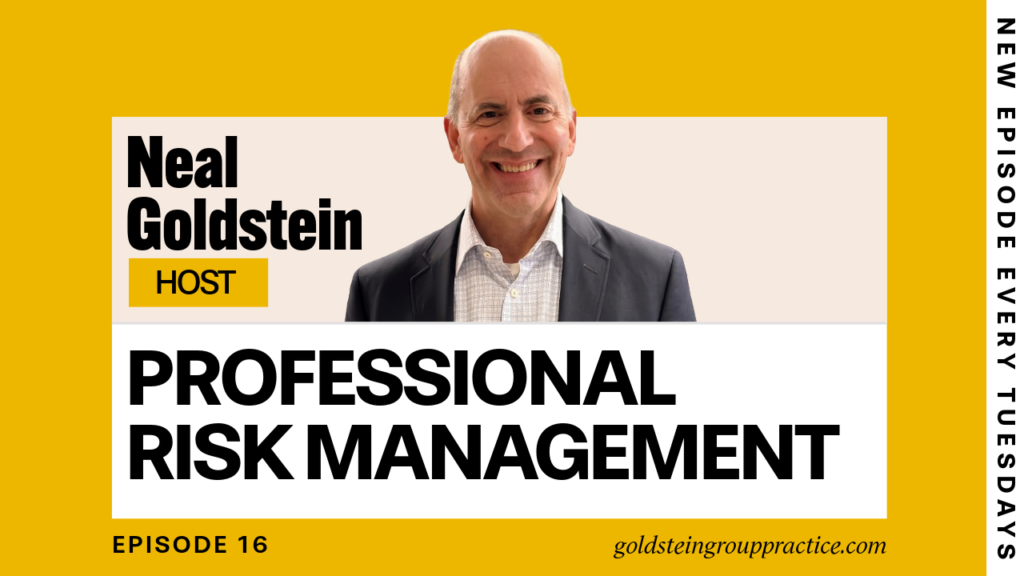
You can learn more about mitigating malpractice risks as a medical group or a physician, and the importance of a dedicated risk manager, in the latest episode of my podcast, Group Practice with Neal Goldstein. You can find the link in the first comment.
In the next episode, I’ll discuss what happens when a malpractice case is filed with Bill Rogers, an exceptional malpractice defense attorney and the panel counsel whose work inspired this entire program.
Neal T. Goldstein is a healthcare attorney and partner at Patzik, Frank & Samotny Ltd., representing physician groups and individual physicians in corporate and transactional matters.