Doctors, Juries, and the Truth About Malpractice Cases: A Conversation with Veteran Malpractice Defense Lawyer Bill Rogers
Here is a fact that should change how every physician views malpractice litigation:
In Cook County, a place with a reputation for being very plaintiff-friendly, doctors win between 65% and 75% of malpractice jury trials.
But most physicians have no idea of this fact, and the reason they do not know is very simple: no one holds a press conference when a physician wins a lawsuit. When it’s a plaintiff that wins, the reverse is the case.
There will be a press release and a segment on the evening news. In hospital cafeterias, the sum awarded as compensation will be discussed for months. But doctors do not make press statements; they go back to the OR, and there’s no evening news coverage.
This system results from the medical profession carrying a fear that available data does not support. The fear is built entirely on cases that went badly and the public only hears about cases that plaintiffs win.
This system was made known to me by Bill Rogers, and I wanted to share his perspective with you. Because if you are a physician worried about the outcome of malpractice litigation, then what I’m about to share will reassure you and show you why doctors lose winnable malpractice cases.
Bill Rogers
But before we get into that, let me introduce Bill Rogers. He is a partner at Swanson, Martin, & Bell in Chicago and has spent decades representing physicians in medical malpractice cases. I met him in the early 2000s when he was defending one of my clients in a case that could have ended badly.
The case involved a sympathetic plaintiff, significant damages, and a malpractice insurance carrier eager to settle. Although there was no breach in the standard of care, the circumstances were complex. But the way Bill handled it led to a favorable outcome and helped me build a professional risk management program.
Bill is also a fellow of the American College of Trial Lawyers and recently received a lifetime achievement award for trial excellence. So, when it comes to malpractice litigation, he is the person you want to hear from.
The Rollercoaster That is Malpractice Litigation
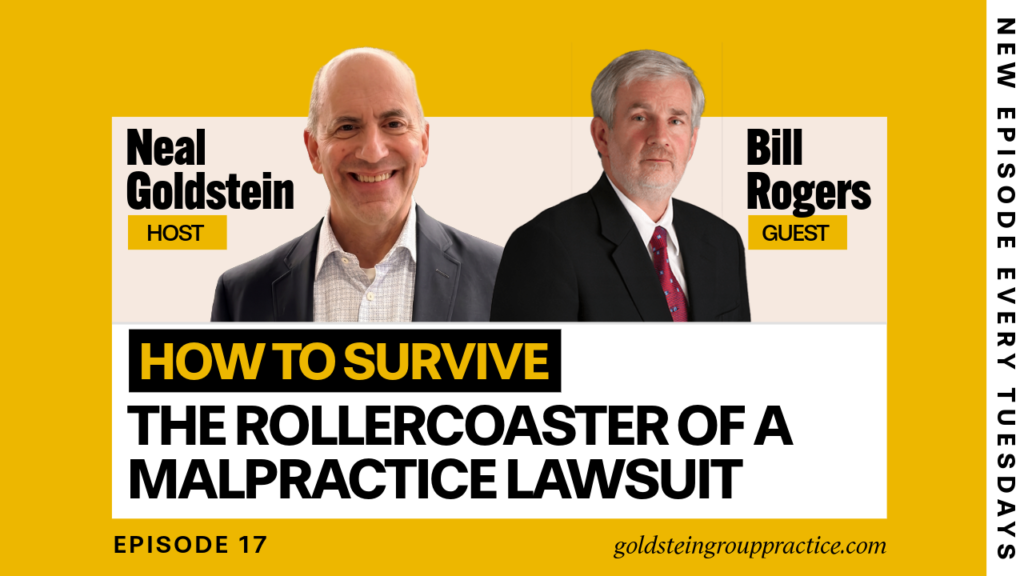
This is why I invited him to the latest episode of my podcast, Group Practice With Neal Goldstein. We broke down some key information about malpractice litigation.
The first thing Bill does when he meets a client is get them to ask questions so they feel less anxious. Then he tells them something I believe every physician should hear: they are about to go on an emotional rollercoaster.
This is because most physicians go from “I want to fight this to the end, I’ll attend every deposition” to “Can you please just make this go away, it is consuming my life” to “I cannot believe I am still in medicine.” These up and down emotions continue till the end of the case.
But eventually, it ends with the physician or plaintiff winning.
The Three Kinds of Malpractice Cases
One of the things that has helped Bill with his cases and results is how he categorises malpractice cases.
Carpentry and Plumbing
The first is what he calls carpentry and plumbing. This refers to cases where the physician performed the wrong-level surgery, left an instrument in the patient’s body, or cut the nerve or duct during a routine procedure. In such cases, the plaintiff wins because the error is concrete and visible.
Questions of Judgment
The second is what he calls questions of judgment. This refers to cases involving reduction or open procedures, laparoscopic or open, prescribing aspirin or Coumadin after a knee replacement. Defendants typically win these cases because they can walk a jury through their reasoning, showing the options they had, the trade-offs, and why they made a certain decision.
The One More
The third is what he calls the “one more.” This refers to cases that involve one more test, one more consult, or one more referral that the plaintiff argues could have changed the outcome entirely. This type of case can go either way.
Most Cases Are Decided by How the Doctor Shows Up
But there is one determinant that affects the outcome of any of these categories: the doctor.
Bill said he had seen seemingly unwinnable cases go the defense’s way because of how the doctor showed up. For example, he once represented a surgeon whose patient became paralyzed after a procedure, and he could not explain why.
The doctor wrote a peer-reviewed article about the case, searching for answers openly, and admitted that he did not know what happened. When Bill went into the trial, he was terrified that the plaintiff had a theory, but the defense did not. However, the doctor’s honesty won them the case, and the jury believed him because he was believable.
But the opposite was the case in another trial. A young orthopedic surgeon missed a fracture on a film. During the trial, the plaintiff’s theory on how that mistake caused the injury was wrong. All the doctor had to say was that although he missed it, it did not matter.
But he couldn’t. He insisted that he studied the film for twenty minutes and saw nothing, while the jury saw the same fracture on the screen in the courtroom. It was plainly visible, and they lost the case.
So, what does this tell us: juries are likely to forgive imperfection. But when a doctor can’t own up to something they can see with their eyes, they can be very unforgiving.
Jurors Are Patients Too
Doctors need to remember that most juries are made up of patients. And according to Bill, most patients like and respect their doctor, and need them. What this means is that when physicians walk into the courtroom, they are already ahead of the person suing them and have the benefit of the doubt in their favor.
However, they can lose that goodwill if they are evasive, arrogant, or do not listen to their lawyer. But, doctors don’t believe they have the upper hand because they have always heard about the friend who lost or the plaintiff who won.
But Bill sees things differently. After decades in the courtroom, he knows that the system, with all its flaws, works for good physicians who show up honestly and let their counsel do their job.
This is what physicians need to hear and why I decided to share this. You can listen to the full conversation with Bill Rogers in the latest episode of my podcast. The link to listen is in the first comment.
Neal T. Goldstein is a healthcare attorney and partner at Patzik, Frank & Samotny Ltd., representing physician groups and individual physicians in corporate and transactional matters.