The Partnership Mistake Physician Groups Keep Making
Do you know that the hardest part of making a physician a partner is not their productivity?
Many physicians and physician groups assume this is the case. This is why, when it comes to admitting a physician into partnership, they focus on only two factors.
The first is productivity. The group looks at how many patients the doctor sees, how efficiently they work, whether they use physician extenders well, and if they keep up with the realities of declining reimbursement. As I’ve said in a previous article, a medical group is a business; therefore, productivity must be a metric when admitting partners.
The second factor is quality. Here, the focus is on the physician’s clinical judgement, surgical outcomes, and the decisions they make when a case becomes complicated.
But there is a third criterion that most physician groups overlook. This criterion is what separates groups that build something that lasts from those that don’t. However, it is the hardest to measure, the most tempting to ignore, and the one a group has to be most disciplined about.
I’m talking about how the doctor treats people.
Why This Criteria Is Overlooked
A doctor can be the most enticing candidate to make a partner, be very productive, excellent in the OR, and never miss a diagnosis. But be rude to staff and condescending to patients.
Although their productivity and excellent track record make them a catch, the way they treat people is a red flag. In such a case, the medical group’s leadership will be tested because their first instinct will be to overlook how the doctor treats people.
After all, their productivity is real, and so are their clinical skills and the income they generate. By comparison, the doctor’s bad behavior is intangible, harder to pinpoint, and put in a performance review. So, most of the time, it is rationalized as “just their personality.”
I do not agree with rationalizing it as a doctor’s personality. Rather than treat it as an intangible factor, groups have to be firmer about it. My decades of experience advising physician groups have taught me that groups have to be sterner with how a doctor treats patients than with their productivity gap or quality concern.
Medical groups have to document every incident of bad behaviour with patients and make it explicitly clear that it is a serious impediment to advancing within the group. If a year passes and there is no improvement, then the doctor should not be admitted as a partner, no matter how productive they are.
I’ll be fair and say my point is not absolute, as bad behavior is not always permanent. Most doctors finish their training in their mid-thirties with thirty years of career ahead of them. Those early years can be a blip.
Over time, productivity improves, and clinical quality deepens as they continue to learn. With the years also comes maturity that softens the rough edges in how the doctor treats people. So, a doctor who does not qualify to be admitted as a partner in their early years will not stay disqualified forever.
My point is to properly examine each doctor using these three factors, and not just based on productivity and quality. The fact that they are productive and profitable should not make you ignore a real problem.
Eligible Does Not Mean Entitled
Of course, deciding who becomes a partner is only half the challenge. The next question is what partnership actually means, and what partners are eligible for or entitled to. A doctor can be made a partner in a medical group, but not have a part in its most valuable assets.
Let’s look at the real estate of medical groups.
Many groups own their own building, and the original partners might have put in a modest capital contribution, for example, about $25,000, when the building was bought or built with debt. Years later, the loan has been paid and the property has appreciated, with the stake now at $100,000 to $150,000 or more.
In many such cases, the group suddenly earns a reputation that buying into the group is too expensive for young doctors. So, they propose what they see as a sensible fix, which is the founding partners keeping the real estate with no option for the new partners to buy in.
Surgery centers are even trickier, because unlike a building that merely houses the practice, an ambulatory surgery center is an extension of the practice — a major profit driver and a genuine selling point to patients. This makes it hard to tell a new partner that they are a partner in everything except the surgery center.
To make such a statement will make being a partner feel like a hollow promotion. If there were to be a buy-in, the anti-kickback safe harbor limits how medical groups can structure the buy-in. It must be at fair market value, have the same terms as everyone, and most importantly, the group cannot finance it.
Real estate can be pay-as-you-go from future distributions, but a surgical center cannot because financing will look like rewarding the doctor for bringing cases. And that is a line that medical groups cannot cross.
Income vs. Equity Partners
All these lead to one question: are partners in a medical group income or equity partners?
This question has been answered by law firms long ago. If you check any law firm’s website, you’ll see attorneys listed as partners. But you won’t see the distinction between equity and income partners because it is made internally.
An income partner is compensated like a partner, meaning they are paid at or near an equity partner’s level based on their productivity. However, they hold no ownership interest, meaning no stock, membership interest, or partnership stake. Also, they have no formal voting rights on important decisions like hiring and firing, closing the practice, or selling the group.
So, in theory, if the group sells, an income partner has no share in the proceeds. Notice I said, “in theory.” This means that if a productive doctor is an income partner and the group sells to private equity, the buyer is purchasing that doctor’s future output.
If the doctor is cut out of the deal, they leave or disengage. So, what we see in practice is the buyer ensuring that they participate through a transaction bonus and rollover equity. But for this to work, the buyer must have the income partner’s trust that the assurance they are giving them is real and not a setup for a bait-and-switch.
I should point out that the income partner practice is more common in law than in medicine. But as physician groups continue to professionalize and genuinely operate as a business, I believe we will see more income partners in place of equity partners.
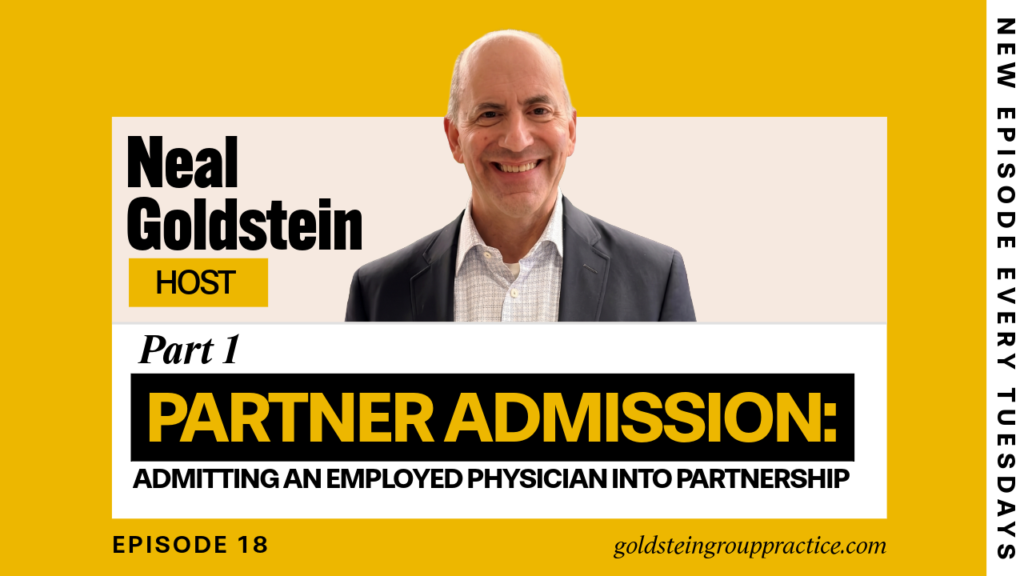
This was the focus of the latest episode of my podcast, Group Practice with Neal Goldstein. It is a two-part series, and in the next episode, I’ll cover the financial mechanics of the buy-in.
Click the link in the first comment to listen to the full episode.
Neal T. Goldstein is a healthcare attorney and partner at Patzik, Frank & Samotny Ltd., representing physician groups and individual physicians in corporate and transactional matters.