Why High Partnership Buy-Ins Can Hurt a Medical Group
There’s a statement that comes up every time a physician group is about to bring in its first partners. It goes like this:
“When I started this practice, I put in my own money. I took less pay for years. I took on debt — a line of credit, equipment loans, and real risk. The new doctor coming in should have to pay what I paid.”
As a result of this statement, many founders do not want partners to buy in for cheap. While this is totally understandable, I’ve understood after three decades of advising physician groups that if left unchecked, the instinct to make the new partner pay as much as the founders invested can be an expensive mistake.
Why? Because in private practice, a partner’s buy-in is not how the founders get paid back what they invested. Having a thriving group is how they make back their money. Therefore, making the buy-in price so expensive, like you want to settle an old score, will only strangle the growth that would have made everyone rich.
To better understand this, I’ll break down how buy-ins work and then explain why expensive buy-ins are the real danger.
Understanding the Framework of Partners’ Buy-In in a Physician Group
There are several aspects to a buy-in, and it helps to separate them.
Hard Assets
This involves the doctor buying into the practice’s balance sheet. Usually, hard assets are valued at net book value, or a “modified” net book value that assigns a floor (often around 10% of original cost) to assets that are fully depreciated on paper but still genuinely useful.
For example, a diagnostic imaging machine that’s worth real money, even though the accountants wrote it down to zero. So, if a practice has expensive equipment, such as in ophthalmology, a third-party valuation can make sense, though it rarely changes the number enough to justify the effort.
Accounts Receivable
This aspect is where things get emotional. When the physician group asks a productive doctor to buy into the receivables they personally generated during their employed years, it can feel deeply unfair. The doctor might have thoughts like, “I earned these, why am I paying for them?”
From an accounting standpoint, it might seem reasonable for the physician to pay for accounts receivable because they will benefit from them in their partner compensation. But perception is reality, and most groups don’t think it is worth the fight and waive it. I have no problem with this as long as the economics were carefully considered and the decision was not made only to keep the peace.
Additional Allotment
The third aspect is additional allotment, which is sometimes framed as organizational cost. It is also sometimes considered a non-punitive figure, which acknowledges that the founders built something that the new partners get to step into.
The Payment Method
Now, no one writes a check for any of these buy-in aspects, as saying to a good young doctor, “Go to the bank as I did,” is a hard sell.
So, the question is, how does a young physician actually pay for all of this?
The mechanics are like this: hard assets and an additional allotment are paid in fixed installments over a two- to three-year period, after tax, and without interest. On the other hand, accounts receivable is handled differently and more cleverly as an income shift.
So, instead of a new partner paying out of taxed dollars, the receivables are shifted on paper to the existing partners over that same period. As such, the money never appears on the new partner’s W-2 or K-1, making it effectively pre-tax.
But there’s a rule that overrides all of these: a new partner should not earn less in their first years as a partner than they did as an employee.
I could come up with an argument on why a dip in a new partner’s earnings would be fair, as it happened to me when I made partner at a law firm. But I won’t, as law firms are not physician groups. And a doctor carrying medical school debt and starting a family will not take a pay cut for the privilege of partnership.
So, to avoid a dip in earnings and follow the rule, payments for partner buy-ins should be structured, and if possible, stretched into five years so that the partner can buy in and still earn what they did before becoming a partner.
Things Are Different With Large Buy-Ins
All we’ve said so far works for small buy-ins. When the numbers are higher, the approaches increase, and I’ll discuss a few worth knowing.
The first is the valuation approach, which tries to import what private equity does, a multiple of EBITDA (Earnings Before Interest, Taxes, Depreciation, and Amortization). The problem with this is that a typical physician group has no EBITDA; it’s all paid to the doctors.
Private equity makes the math work by requiring doctors to take less compensation to create EBITDA. But in a partnership where nobody’s taking a pay cut, the model does not translate cleanly.
Another approach is the “formula for our speciality and region” that groups cite with the utmost confidence. With this approach, you hear statements like, “This is what ENT practices in the Southwest charge,” without any published and objective data to back it up. As a result, I always push back whenever this formula comes up because if a group can’t show me where the numbers come from, then it’s nothing but an anecdote dressed up as standard.
The third approach is one that I’ve never seen medical groups adopt, even though every law firm I’ve worked at uses it: the capital retention method. Here, each partner must keep a set percentage of their compensation, for example, 60%, in a capital account.
This formula applies to everyone equally, and as I tell groups that I represent, everybody hates it, which is part of why it is fair. I believe organizations be capitalized, whether they are law firms or physician groups. And I suspect that most physician groups will come around to it as they keep professionalizing into the business.
The last approach is the path to parity. It is a more gentle model, and works like this: an employed doctor makes partner ramps up to full partner compensation over five years — 20%, 40%, 60%, 80%, 100% — gradually retaining the profit the group used to make off their work.
This approach is not only fair, but it also generates meaningful buy-in, and it works best when it starts early in someone’s tenure rather than in year seven.
The Two Questions That Matter
Now, if you take away the mechanics, then every buy-in comes down to two philosophical questions:
When Is a Buy-In Too Low?
If the goal of a physician group is to grow, then my answer is rarely. Imagine a large Midwestern group sets a buy-in at $20,000; it would be considered absurdly low by conventional standards. But that group then becomes enormous because they set their buy-in at that amount, encouraging doctors.
This means that the more productive partners you bring in, the more everyone earns. So, a low buy-in should not be seen as money left on the table, but the price of growth. And ultimately, every medical group aims to grow.
When Is a Buy-In Too High?
A buy-in is too high if you can’t grow with it. High buy-ins are seen more often with smaller groups, as larger ones can’t get away with it and still grow. The buy-in sums are figures that shock the conscience.
Imagine asking a doctor two years out of fellowship, still carrying medical school debt, to pay an amount that only serves to satisfy a founder’s sense of what they are owed. But does this mean that a high buy-in is never justified?
No.
Every speciality and region differs and can justify a high buy-in. So, when I counsel a young doctor looking at a big number, I tell them to look at the long run. “You’re going to make more than you ever dreamed in this practice. Will it really matter in twenty years that you paid more than some doctor down the road, when you’ve built the career you wanted?”
If I am representing the group, and a high buy-in is what they insist on, I respect it. However, I will ensure they understand what it might cost them if productive doctors do not buy into their group.
So, as founders of a physician group, you must determine whether growth is your end goal or recovery of what you spent to build the practice.
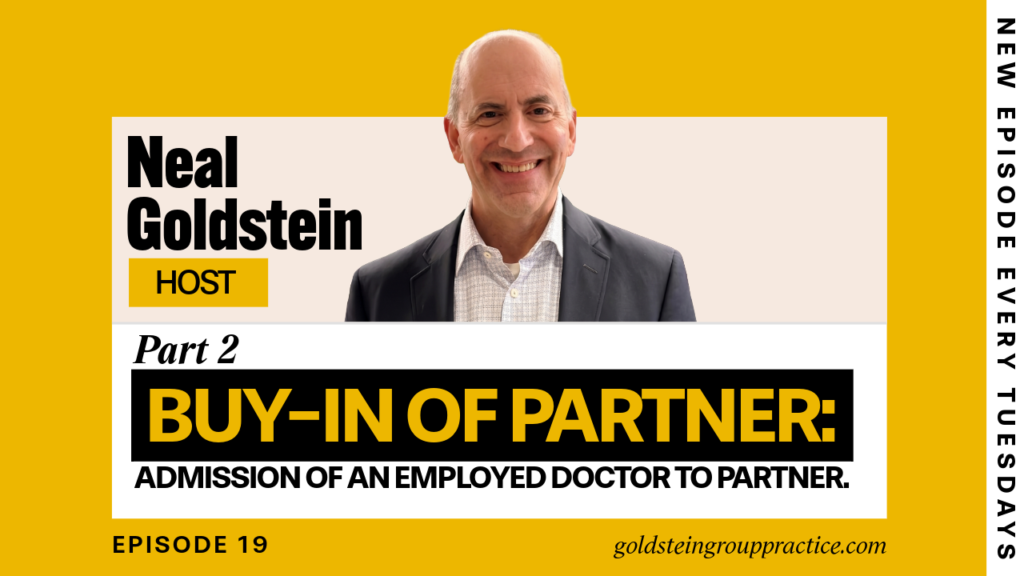
I discussed this as the second part of a two-part series on my podcast, Group Practice With Neal Goldstein. The link to listen is in the first comment, and next week, I’ll discuss buyouts: what happens and what it costs when a partner leaves.
Neal T. Goldstein is a healthcare attorney and partner at Patzik, Frank & Samotny Ltd., representing physician groups and individual physicians in corporate and transactional matters.