The Fairest Way to Buy Out a Retiring Physician
When a physician group wants to buy out a retiring partner, they often go for labels that sound sophisticated, like an appraisal, a valuation, or a multiple. In my experience, the cleanest and the most defensible is simpler than these fancy words, and it starts with a principle you can explain in one sentence:
“The buyout should mirror the buy-in.”
The amount may not be identical, especially if the group has grown. In such an instance, the buyout amount should exceed the buy-in. The components, the building blocks of what a departing partner receives, should look like the components of their buy-in.
If the buyout is structured this way, it makes it easy to explain and hard to argue with, making defensibility worth more than cleverness. Today, I’ll share with you the three components of a buyout, how they get paid, and what separates good leavers from bad leavers.
The Three Components of a Buyout
Like a buy-in, a buyout has three parts:
● The hard assets, valued at net book value or a modified version of it;
● The accounts receivable, both the doctor’s own and their share of the ancillaries like imaging, lab, and physical therapy; and
● An additional amount, whether a fixed sum everyone paid in or a goodwill figure.
It is important to know the mechanics of paying out each of these parts.
Hard assets get paid over two to three years, or in a lump sum if the number is small. On the other hand, accounts receivable get paid as they are collected, month by month, less a billing charge to reflect what the collection actually costs. The key discipline here is time-limiting that tail as most receivables arrive within the first ninety days.
So, you can cap the collection window at 12 to 18 months, 24 at the outside. Doing this is important as you do not want to be cutting fifty-dollar checks to a partner who retired five years ago. Also, it becomes a drain and a distraction, and the practice needs to move on.
Furthermore, you need to cap how much flows to a redeeming partner in any single year. This is often tied to a percentage of the ancillary profits, and when only one partner is leaving, it will not matter much.
When several partners are redeeming at once, it matters a great deal because the group’s profits should not be disproportionately consumed by paying those who left. The buy-out should be a benefit, not a wound the group inflicts on itself.
The Good and Bad Leavers
Keep in mind that no matter how well you structure a buyout, there will be good and bad leavers, making this where human judgment enters. A well-structured buyout will earn its keep, but not everyone who leaves will leave the same way, and the buyout should reflect it.
A good leaver is someone who gives the required notice and retires in good standing. The notice is important, and not as a formality. In many specialties, you need 12 to 24 months to recruit a replacement, especially if you are hiring from a fellowship that ends in July. Giving sufficient notice lets the group bring on that replacement early enough and lets the retiring doctor onboard and mentor them.
A bad leaver is different. When a doctor fails to give sufficient notice, they leave the entire group scrambling, unable to recruit in time, and absorbing overhead with one fewer revenue generator. In such a situation, it is entirely reasonable to charge more than the modest billing fee against their collections.
So, if the group’s overhead runs 50%, applying that overhead charge to a bad leaver’s receivables is fair because their abrupt departure deprived the group of the chance to replace the revenue.
The Case That Surprises People: Leaving for the Sun
Beyond the good and bad leavers, there is a harder question: what about the doctor who does everything right, gives full notice, honors the non-compete, but moves to Florida or Arizona to practice in a warmer climate outside the restricted area?
This doctor is not competing or in breach. Do they get the full buyout?
Personally, I structure the buyout in a way that they do not. They will get something, but not the full amount. Why?
The reasoning behind this lies in what a buyout actually is. A buyout is best understood as a retirement benefit, a reward for years of service and an incentive to spend an entire career with the group, which is the foundation of good succession planning.
When a doctor decamps to start a new practice, they have not retired from medicine; they just took their practice elsewhere. And in most cases, this move does not sit well with the partners staying behind, and working to fund a buyout for someone enjoying the good life elsewhere.
I stand behind groups that limit the buyout for such doctors and have defended it in litigation. I’ve handled a case where a doctor left, came back to challenge their buyout, took the case to court, and we won at trial and on appeal.
The winning argument is one I keep returning to: a buyout is a benefit, like the free tail a malpractice carrier gives a retiring physician. It is a reward for finishing your career with the group, not an entitlement you carry out the door to your next practice.
The Non-Compete
Now, while most of the issues regarding a buyout are in the gray, a non-compete is not. If a doctor leaves and breaches their non-compete, actually competing against the group in violation of their agreement, my documents say they forfeit the buyout entirely. In addition to whatever rights the group has to enforce the non-compete itself.
The logic behind this is black and white. If you are going to leave and actively harm the group, you do not also get to be rewarded with a buyout for the privilege. That would be inequitable on its face.
The Argument for Private Equity
There’s another objection that has become unavoidable, and it has become the reason why many physicians resist mandatory redemption: the private equity payday.
Even if a buyout equals the buy-in, and the group grows exponentially, the amount will never be the same as what a doctor gets for selling to private equity. So, in most cases, the retiring partner argues: private equity sets the market, so pay me what PE would.
This argument is understandable, but it does not hold because it is like comparing apples to oranges. A PE payment is not a gift; it is compensation for the scrape, the reduction in go-forward salary that younger doctors accept for years to create the EBITDA the buyer is purchasing.
The redeeming doctor wants the PE-sized check without ever having lived under that reduced-compensation model for the balance of their career. Once you actually explain what a PE sale entails, and I encourage groups to sit down and walk a retiring partner through it, the argument tends to dissolve.
However, there is a version of this concern that is fair, and groups should take it seriously. What if the group buys out an older partner cheaply and then sells to PE six months later at a fortune?
This is a real arbitrage worry, and although I can argue it does not technically apply, transparency is worth more than being right. Therefore, to keep harmony within the group and reassure partners that there is no hidden agenda, build in a trailer: if a PE sale closes within a defined window, say six months or a year, the redeemed doctor participates.
Note that it can get complicated, and I would not necessarily put it in the first draft. But offering it sends a message that matters more than money. It lets your partners know that it was never about buying out senior partners cheaply to enrich everyone else, but about succession, and applying it honestly and uniformly.
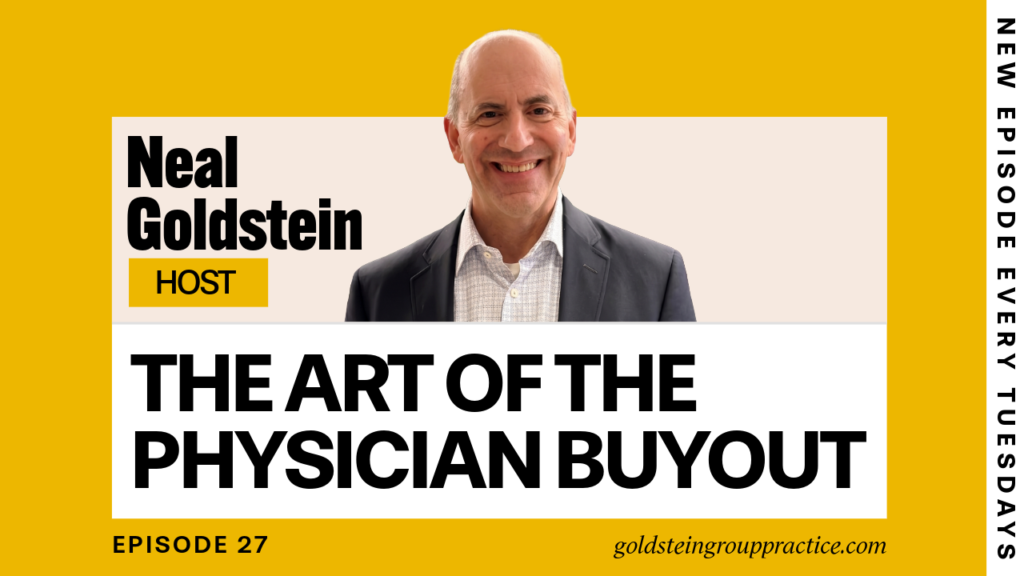
I broke this down extensively in the latest episode of my podcast, Group Practice With Neal Goldstein. In the next episode, I will discuss an issue that keeps repeating: the physician at the tail end of a career who wants a wind-down path, rather than going from sixty miles an hour to zero in a single year.
Click the link in the first comment to listen to the recent episode.
Neal T. Goldstein is a healthcare attorney and partner at Patzik, Frank & Samotny Ltd. (“PFS”), representing physician groups and individual physicians in corporate and transactional matters. This article is general commentary, not legal advice for any specific arrangement. The views expressed by Neal Goldstein and guests of the podcast are their own and do not necessarily reflect the opinions of PFS, nor should the views be attributed to any client of PFS.