How Physicians Can Build Great Businesses: A Conversation With Scott Becker
In December 2025, I sent a text to an old friend telling him that I felt marketing a law practice was too much work for a small audience, and asked if he had a social media consultant he could recommend.
His response was unexpected, and it changed my professional life. He told me I did not need a social media consultant; that I should do a podcast instead. Although I objected that no one would listen to my podcast at the time, he encouraged me to go ahead.
And I did!
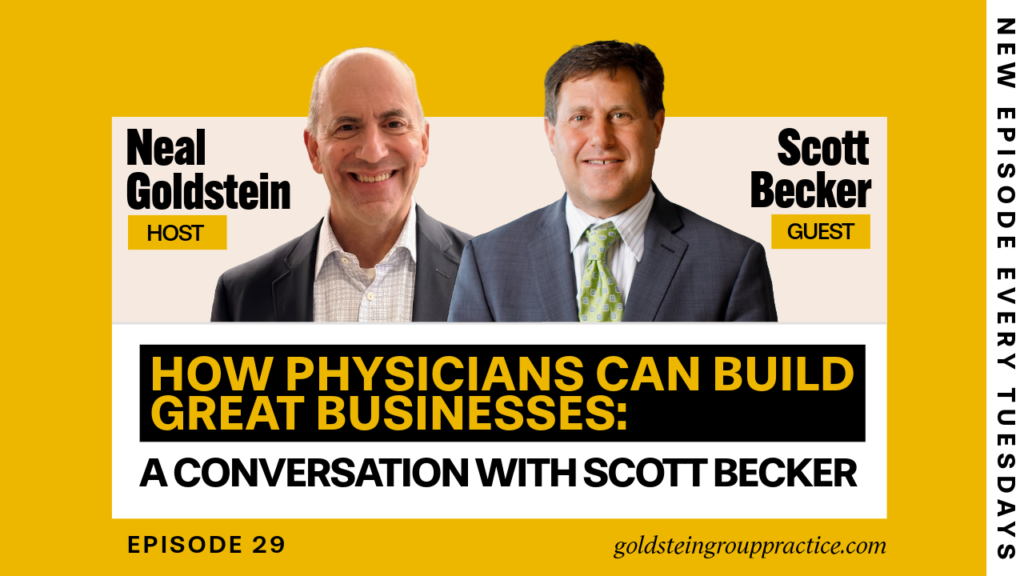
To date, I have aired 29 episodes of Group Practice With Neal Goldstein, and in the latest episode, my guest was none other than that friend, Scott Becker. I had a great conversation with him about how physicians can build great businesses, and I’m sharing some excerpts with you.
But before I get into them, let me introduce Scott Becker to you. Scott has been shaping my career decisions for over 25 years. He is the founder of Becker’s Healthcare and a longtime partner at McGuireWoods, where he chaired the healthcare department.
Scott is also a Harvard-trained lawyer, a prolific author, and a host of two of the most-listened-to podcasts in the industry. He recently published a book called Building Great Businesses, which is the bedrock of our discussion.
Three ideas stood out to me that I believe every physician thinking about the future of their practice should know.
Take a Step Even When You’re Not Certain
The first thing that stood out is this quote from Reid Hoffman, the co-founder of LinkedIn: “If you are not embarrassed by the first version, you launched too late”
This means you do not always have to wait for the perfect plan. According to Scott, you need to try new things, read the signals, and double down on what is working. He exemplified this with the number of books he has written.
To him, his first business book was a D, the next one was a B-, and Building Great Businesses is the one he is proud of, and it only exists because he was willing to publish the earlier, worse versions and learn from them.
When it comes to physicians, they are trained to operate the opposite way. Medicine rewards precision and punishes error. But businesses do not work like this. When a physician carries this mentality into the business side of their practice, it becomes paralysis, as you will wait for certainty that will never come.
Scott’s career in the healthcare field is a case study in the opposite. The surgery center niche he developed which everybody said was genius was, according to him, one of the areas he was testing among others. But it grew, and he followed it. What is important to note here is that he could not have known in advance that it would be successful; he simply refused to stand still while he found out.
Find the Niche Within the Niche
The next idea that stood out is something Scott said in the year 2000 that he still believes very much in: find your niche, and grow it. When Scott said these words to me, I was wondering whether I wanted to spend my career as a lawyer for physicians. But I followed his advice and built a career I never envisioned for myself.
It is always important to find your niche and stick with it. When Scott chose healthcare, his colleagues warned him that it would cut him off from the rest of the economy. But he saw that healthcare was 20% of the economy, so it was a smart strategy to test out. And he did not stop there.
He went further into niches within the niche!
He saw younger colleagues who were strong lawyers struggle in private equity, the single most competitive field in law and dominated by only a handful of firms. When those colleagues moved into the niche of private healthcare equity, they stood out and built tremendous practices. This happened not by being in healthcare or private equity, but by combining the two into something they owned.
The lesson here is clear for physicians: the market rarely rewards being another general provider in a crowded field. It rewards focus, and the specialists thriving today are those who went narrow.
For example, the OB who moved into fertility and is happier and busier for it, the spine surgeon on the East Coast with more physicians wanting to join him than he can accommodate, the primary care doctors building concierge practices that outearn their old salaries.
So, private practice is not dying. It is undifferentiated practice that is struggling, while focused private practice is thriving.
The Real Threat Is Not the Hospital
This is why I always say that the demise of private practice is greatly exaggerated, and that a nimble independent group can compete with a hospital system. Scott agrees with this, and he took it a step further.
According to him, the biggest threat to physicians is not hospital competition, but the physicians who cannot get out of their own way, especially at the level of their trade associations. Consider this math he laid out:
This country trains roughly 30,000 new doctors yearly and 200,000 nurses. It takes about 12 years to produce a physician here, versus eight in some other countries, and that extra time is a real deterrent to the best and brightest.
Meanwhile, there are around 27,000 oncologists for two million new cancer diagnoses a year. Every oncologist you know is exhausted and burned out, and yet the specialty societies remain far more focused on limiting residency slots than expanding them.
The point here is not anti-nurse or anti-PA, as many of them are excellent and demographics guarantee they will carry more of the load as the population ages. However, if the physician guilds keep protecting scarcity, they will wake up one day to find that the vast majority of the care has moved to nurse practitioners, PAs, and AI, and it won’t matter if that is the best option for patients.
This reframing matters for independent practice owners. It will help the fight for the future of private practice and is not only won or lost against the hospital down the street. It is also won or lost in whether the profession chooses abundance over protectionism.
The Thread Running Through It All
Finally, when running a business, your mindset should be “we,” not “I.” Scott never says, “I.” He built Becker’s Healthcare by finding talented people, spotting someone like his longtime partner, Jessica Cole, when she was still in college, and empowering them rather than hoarding credit.
As he puts it, there is great satisfaction in being indispensable, but there is great value in being dispensable. One reason he is still at McGuireWoods is that most of the people who came up under him now outearn him and are thriving. He considers that the point, not the price.
Scott’s book Building Great Businesses covers this, and it is worth every physician’s time because he described businesses that are built the way a thriving group practice is built. Ultimately, you need focus, the willingness to try, fail, and adjust, and a genuine belief that you go further with a team than you ever could alone.
Building Great Businesses is available to order on Amazon. You can listen to our full conversation—the most personal and wide-ranging I’ve had so far on my podcast—by clicking the link in the first comment.
Neal T. Goldstein is a healthcare attorney and partner at Patzik, Frank & Samotny Ltd. (PFS), representing physician groups and individual physicians in corporate and transactional matters. This article is general commentary, not legal advice for any specific arrangement. The views expressed by Neal Goldstein and guests of this podcast are their own and do not necessarily reflect the opinions of PFS, nor should the views be attributed to any client of PFS.