Why Physician Groups Should Never Treat a Medical Office Lease as "Standard"
Let me tell you a short story.
Years ago, I represented a client in a series of leases with a landlord that insisted on a 3% management fee. With the assistance of a good tenant broker, I pushed back 2% and finally settled for 2.5%. You should note that my client was a strong credit tenant, so we had leverage.
The half percentage point I negotiated for my client saved them substantial dollars over ten years. Although they initially did not like my bill or how gut-wrenching and expensive the negotiation got, the return they got in the end made it worth it.
This story captures the whole point I want to make about leasing your medical office space. A lease is more than a document you sign; it is a document you negotiate, and doing it right requires expertise that doctors simply don’t have.
I know this not only from representing clients, but from sitting in the client’s seat myself. When my firm’s lease was coming up for renewal, I was part of the four-partner team that spent many months searching for and negotiating our new space at 200 South Wacker in Chicago.
I learned a lot from being the client rather than the lawyer, and most of what I learned applies just as much to a physician group as it did to our law firm. And I’m sharing them with you so you know what to do when negotiating your next lease.
You Need These Two People
The biggest lesson is that leasing depends on these two experts: a tenant broker and a real estate leasing lawyer. If you skip either one, your practice will be hurt by the decision.
The Tenant Broker
The tenant broker, specifically one with medical office expertise in your region, is crucial. An experienced tenant broker has local knowledge of the real estate market, knows what space is available, what is about to become available, the current real estate rates, and how to interpret all of it.
With the advent of AI, most people have easier access to information, and as a result, they think they can figure the market out for themselves. The truth is, you cannot. Even if every figure were public, interpreting what rental rates actually mean and what leverage you have is the broker’s entire craft.
The best part about using a tenant broker is that the landlord is the one who pays their commission. Their fee does not have to come from your pocket, but effectively is built into the rent. This is why I’m always astonished that more people are not using tenant brokers.
However, I should point out that when choosing a broker, they must be independent and at arm’s length. I have seen a practice use a tenant broker who was also their partner in owned real estate, or their close friend, the developer.
Such a person is the wrong one to use because their lens often shifts to what benefits the individual doctor-investors and not what is best for the practice as a tenant. So, you need a broker that has the right expertise and qualifications and can advise you objectively.
The Real Estate Leasing Lawyer
The real estate leasing lawyer has the expertise you need to review the terms. I started my career as a real estate lawyer doing acquisitions, dispositions, development, zoning, mortgages, and leasing, and learned that this was a niche.
Therefore, you do not need just any real estate lawyer, but one with experience and expertise in lease agreements. Even with my background as a real estate lawyer, I still bring a dedicated leasing lawyer onto every medical office lease I handle.
Why? Because I know that they will catch things that I won’t, since that is their field. Also, I do not handle lease agreements every day or as often as they do. So if I, as a lawyer, insist on this, then you, as a physician, should insist even more.
The Term Sheet and the Lease
Now, here is a framework that I believe makes the roles of a tenant broker and the real estate lawyer click.
The tenant broker negotiates the term sheet: rent, term, whether it is a gross lease or a net lease with pass-throughs, plus more advanced points like common area maintenance charges, rights of first refusal on nearby space, and relocation rights. The term sheet might run five to seven pages, but becomes thirty, forty, or fifty pages when the landlord draws up the lease.
So, think of the term sheet like a statute: it lays out the broad intent and major parameters. The lease, on the other hand, is the regulation that carries that intent into practice, filling in all the necessary details.
Just as Congress writes the statute but hands the agency the job of writing the regulations, the broker gets the deal to a signed term sheet, and then the lawyer takes the lead on the lease itself.
The lawyer’s first job is to confirm that the five-to-seven-page term sheet actually made it, faithfully, into the fifty-page lease. Note that it is rarely copied word for word, and making sure nothing was quietly lost or reshaped takes real skill. Thankfully, a lawyer has that skill.
Where the Real Money Hides
Once you’re into the lease, there are a few areas worth every hour of legal fees you’ll pay. Let’s examine them one after the other.
Operating Expenses
In all my years representing clients, I have never seen a first draft that a tenant looks at and says the landlord gave them everything they wanted. What you see is landlords allocating as many costs as possible across the tenants, defining those costs liberally, always in their favor.
When signing a lease, what you want is the opposite. You want it clear that truly structural capital improvements, a new roof, the electrical systems, are not simply dumped on you, or if they are passed through, that they are amortized fairly.
If the landlord installs a fifteen-year roof in year seven of your ten-year lease, you should bear three years of it, not all of it. The management fee example above lives here too because these items add up fast.
Obligations at Lease Expiration
Most lease agreements state that the tenant will return the premises in their original condition, ordinary wear and tear excepted. This is standard. But what if the lease says you must remove fixtures?
That word is dangerous for a medical practice because what amounts to a fixture? Is an MRI a fixture, with the specially built walls around it? A linear accelerator bolted to the floor with lead-lined walls?
You want it crystal clear that you own the valuable equipment, and you want the removal and restoration obligations negotiated up front. Why? Because nobody cares about this on day one when everyone just wants to get in, and I have watched a client get sued over exactly what they owed at the end of a lease.
Landlord Remedies
The first draft from the landlord will be full of benefits for them. Expect easy paths to declare a default, short cure periods, punitive holdover terms, and a one-month holdover deemed to exercise a full extension.
Know that you are likely not going to flip all of that to pro-tenant. But you must get those remedies to be fair, reasonable, and balanced, so that a neutral reader would call the lease even-handed at a minimum.
Although you cannot point to a dollar figure this saved you on day one, you will understand exactly what those negotiated terms were worth the day the landlord wants you out.
God Is in the Details
I always say that the devil is in the details, and out of curiosity, I decided to look up where the saying came from. Among the various sources is a wonderful one for a conversation about buildings: the great Chicago architect Ludwig Mies van der Rohe, who designed the Seagram Building and the IBM Building, and who put it the other way around. His version was “God is in the details.”
It might seem a touch dramatic for a real estate lease, but it makes the point. The general terms get the headlines, but the details are the essence of the lease, and the details are the essence of your business.
They are what your leasing lawyer, working with your tenant broker, exists to get right. Therefore, do not sign the standard-looking document because it looks standard. Get the two experts, negotiate the details, and treat the lease with the seriousness your practice deserves.
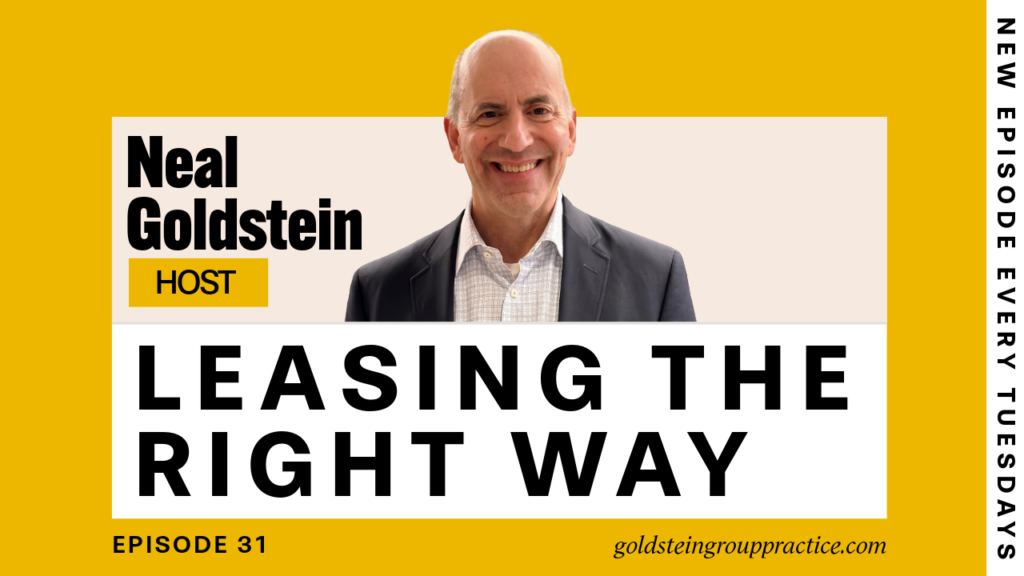
This topic is a follow-up to my previous article and podcast topic on whether to own your own building as a medical practice. You can listen to the full conversation on Group Practice with Neal Goldstein via the link in the first comment.
Neal T. Goldstein is a healthcare attorney and partner at Patzik, Frank & Samotny Ltd. (PFS), representing physician groups and individual physicians in corporate and transactional matters. This article is general commentary, not legal advice for any specific arrangement. The views expressed by Neal Goldstein and guests of this podcast are their own and do not necessarily reflect the opinions of PFS, nor should the views be attributed to any client of PFS.